上一章把灰度图像放到设备上,并区分了上传、计算和下载。本章假设输入已经是连续存储的单通道灰度图,研究核函数怎样读取这些数据。我们先写直接读取九邻域的 3×3 均值滤波,再用共享内存让同一线程块内的线程复用输入,最后分别检查结果和测量时间。阅读前需要理解二维线程坐标、cudaMalloc、cudaMemcpy 与核函数启动;本章代码仍需可用的 CUDA 设备与工具链。
1. 九邻域与全局内存访问
均值滤波规则
每个输出像素取输入中以它为中心的 3×3 九个位置,求和后除以 9。图像外的位置按 0 处理,这称为零填充;即使靠边缘的有效像素,分母仍然是 9。输入和输出都按行优先顺序存放,(x, y) 的线性下标是 y * width + x。本章使用整数除法,直接版、分块版和 CPU 参考实现的结果可以逐字节比较。
例如,一张 5×5 全零图像只有中央像素为 255。中心周围 3×3 范围内的九个输出都等于 255 / 9 = 28,其他输出为 0。另一张只有一个像素且值为 255 的 1×1 图像,输出同样为 28,因为其余八个邻居都在图像外。这两组输入用于检查边缘语义。
直接读取
直接核函数为每个有效输出像素循环读取九个输入位置。相邻输出的邻域大量重叠:例如同一行左右相邻的两个输出,各自所需的九个位置中有六个相同。对于没有触及边界的 16×16 输出区域,源码层面最多执行 16 × 16 × 9 = 2304 次全局输入读取。GPU 缓存可能让重复读取不必每次都访问显存,所以这个数字不是实际显存事务数。
同一行相邻线程处理相邻的 x,通常会访问相邻的输入地址,有利于全局内存访问合并。是否真正合并成多少次事务,取决于硬件、对齐和访问位置;不能只凭源码计数推断带宽。CUDA 最佳实践指南的全局内存访问章节解释了合并访问和数据复用的区别。
2. 共享内存分块
输出块与输入块
本例每个线程块有 16×16 个线程,负责最多 16×16 个输出像素。因为滤波半径为 1,这些输出还需要四周各一圈输入:16×16 输出块对应 18×18 输入块。外圈常称为 halo;不同线程块各自加载自己的外圈,即使它与邻块重叠。
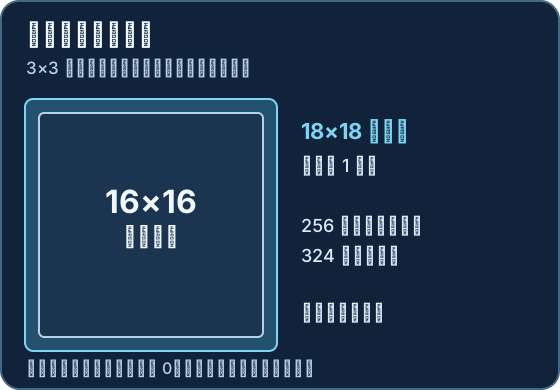
| 区域 | 尺寸 | 作用 |
|---|---|---|
| 输出块 | 16 × 16 = 256 个位置 |
每条线程至多写一个有效输出。 |
| 输入块 | 18 × 18 = 324 个字节 |
16×16 中心加四周一圈,放入块内共享内存。 |
| 输入块边缘 | 超出图像的位置写为 0 |
与直接版的零填充规则一致。 |
加载时先把线程在块内的二维编号线性化,令 256 条线程共同填满 324 个共享内存位置:前 256 个位置各由一条线程加载,剩余 68 个由前 68 条线程再加载一次。每个共享内存位置只由一个线程写。加载完成后全块执行一次 __syncthreads(),确保任何线程读取邻居之前,其他线程对共享内存的写入已经完成。边缘的无效输出线程也必须先参与加载和同步,不能在屏障之前提前返回。CUDA 编程指南的线程块同步说明明确了这一等待范围。
内区块的代码级全局输入加载从最多 2304 次降为 324 次;随后九邻域从共享内存读取。代价是加载外圈、一次块内同步和每块 324 字节的共享内存。线程用于累加的 sum 是线程私有变量,编译器通常尝试把这类变量放在寄存器中;实际寄存器占用仍由编译结果决定。共享内存占用、寄存器数量和同步开销都会影响可同时驻留的线程块,因此“减少全局读取”不保证“运行一定更快”。
3. 完整对照程序
练习目录与编译
在博客仓库之外建立 gpu-practice/shared-memory/,把下面整个代码块保存为 UTF-8 编码的 box_blur.cu。Windows 在 Visual Studio Developer PowerShell 中进入该目录后执行:
nvcc -Xcompiler /utf-8 box_blur.cu -o box_blur.exe
.\box_blur.exe
Linux 执行:
nvcc box_blur.cu -o box_blur
./box_blur
程序使用三个独立输入:5×5 的中心亮点、1×1 的边界案例,以及 1003×769 的确定性灰度图。前两组可以手算,第三组用于观察较大输入。每组均先生成 CPU 参考值,再分别运行直接版和共享内存版,下载并检查全部像素;仅当较大图像的两种结果都正确时才进入计时。
#include <cuda_runtime.h>

#include <chrono>
#include <cstddef>
#include <cstdlib>
#include <iomanip>
#include <iostream>
#include <vector>

#define CUDA_CHECK(call)                                                    \
    do {                                                                    \
        const cudaError_t error = (call);                                   \
        if (error != cudaSuccess) {                                         \
            std::cerr << "CUDA error at " << __FILE__ << ':' << __LINE__    \
                      << ": " << cudaGetErrorString(error) << '\n';       \
            std::exit(EXIT_FAILURE);                                       \
        }                                                                   \
    } while (false)

constexpr int kBlock = 16;
constexpr int kTile = kBlock + 2; // 每边增加一个输入像素。
using Clock = std::chrono::steady_clock;

// 越界邻居取 0;有效输入按行优先顺序读取。
__device__ unsigned char sample(const unsigned char* input,
                                int x, int y, int width, int height) {
    if (x < 0 || x >= width || y < 0 || y >= height) {
        return 0;
    }
    return input[y * width + x];
}

// 基线:每个有效输出线程直接从全局内存读取九邻域。
__global__ void blur_direct(const unsigned char* input, unsigned char* output,
                            int width, int height) {
    const int x = blockIdx.x * blockDim.x + threadIdx.x;
    const int y = blockIdx.y * blockDim.y + threadIdx.y;
    if (x >= width || y >= height) {
        return;
    }
    int sum = 0;
    for (int dy = -1; dy <= 1; ++dy) {
        for (int dx = -1; dx <= 1; ++dx) {
            sum += sample(input, x + dx, y + dy, width, height);
        }
    }
    output[y * width + x] = static_cast<unsigned char>(sum / 9);
}

// 分块:全块先协作加载 18×18 的输入,再从共享内存读取九邻域。
__global__ void blur_tiled(const unsigned char* input, unsigned char* output,
                           int width, int height) {
    __shared__ unsigned char tile[kTile * kTile];
    const int local = threadIdx.y * kBlock + threadIdx.x;
    const int x = blockIdx.x * kBlock + threadIdx.x;
    const int y = blockIdx.y * kBlock + threadIdx.y;

    // 256 条线程覆盖 324 个位置;部分线程会再加载一个位置。
    for (int i = local; i < kTile * kTile; i += kBlock * kBlock) {
        const int tile_x = i % kTile;
        const int tile_y = i / kTile;
        const int image_x = blockIdx.x * kBlock + tile_x - 1;
        const int image_y = blockIdx.y * kBlock + tile_y - 1;
        tile[i] = sample(input, image_x, image_y, width, height);
    }
    __syncthreads(); // 所有线程,包括无效输出线程,都要到达此处。

    if (x >= width || y >= height) {
        return; // 屏障之后才可跳过图像外的输出。
    }
    int sum = 0;
    for (int dy = 0; dy < 3; ++dy) {
        for (int dx = 0; dx < 3; ++dx) {
            const int i = (threadIdx.y + dy) * kTile + threadIdx.x + dx;
            sum += tile[i];
        }
    }
    output[y * width + x] = static_cast<unsigned char>(sum / 9);
}

// 两种实现共用启动配置,以便对照相同尺寸和边界。
void launch(bool tiled, const unsigned char* input, unsigned char* output,
            int width, int height, dim3 grid, dim3 block) {
    if (tiled) {
        blur_tiled<<<grid, block>>>(input, output, width, height);
    } else {
        blur_direct<<<grid, block>>>(input, output, width, height);
    }
}

// 先预热,再用 CUDA 事件测多次启动的平均 GPU 时间。
float kernel_ms(bool tiled, const unsigned char* input, unsigned char* output,
                int width, int height, dim3 grid, dim3 block) {
    constexpr int repeats = 100;
    for (int i = 0; i < 3; ++i) {
        launch(tiled, input, output, width, height, grid, block);
    }
    CUDA_CHECK(cudaGetLastError());
    CUDA_CHECK(cudaDeviceSynchronize());

    cudaEvent_t start, stop;
    CUDA_CHECK(cudaEventCreate(&start));
    CUDA_CHECK(cudaEventCreate(&stop));
    CUDA_CHECK(cudaEventRecord(start));
    for (int i = 0; i < repeats; ++i) {
        launch(tiled, input, output, width, height, grid, block);
    }
    CUDA_CHECK(cudaGetLastError());
    CUDA_CHECK(cudaEventRecord(stop));
    CUDA_CHECK(cudaEventSynchronize(stop));
    float total_ms = 0.0f;
    CUDA_CHECK(cudaEventElapsedTime(&total_ms, start, stop));
    CUDA_CHECK(cudaEventDestroy(start));
    CUDA_CHECK(cudaEventDestroy(stop));
    return total_ms / repeats;
}

// 复用已申请的缓冲区,计入上传、启动、等待和下载的主机时间。
double roundtrip_ms(bool tiled, const std::vector<unsigned char>& input,
                    std::vector<unsigned char>& host_output,
                    unsigned char* d_input, unsigned char* d_output,
                    int width, int height, dim3 grid, dim3 block) {
    constexpr int repeats = 20;
    const std::size_t bytes = input.size() * sizeof(unsigned char);
    const auto begin = Clock::now();
    for (int i = 0; i < repeats; ++i) {
        CUDA_CHECK(cudaMemcpy(d_input, input.data(), bytes,
                              cudaMemcpyHostToDevice));
        launch(tiled, d_input, d_output, width, height, grid, block);
        CUDA_CHECK(cudaGetLastError());
        // D2H 在默认流中排在核函数之后;返回时这一轮输出可供主机读取。
        CUDA_CHECK(cudaMemcpy(host_output.data(), d_output, bytes,
                              cudaMemcpyDeviceToHost));
    }
    const auto end = Clock::now();
    return std::chrono::duration<double, std::milli>(end - begin).count()
           / repeats;
}

bool compare(const std::vector<unsigned char>& actual,
             const std::vector<unsigned char>& expected,
             int width, const char* name) {
    for (std::size_t i = 0; i < expected.size(); ++i) {
        if (actual[i] != expected[i]) {
            std::cerr << name << " mismatch at (" << i % width << ", "
                      << i / width << "): CPU=" << static_cast<int>(expected[i])
                      << ", GPU=" << static_cast<int>(actual[i]) << '\n';
            return false;
        }
    }
    return true;
}

bool run_case(const std::vector<unsigned char>& input, int width, int height,
              bool measure) {
    if (width <= 0 || height <= 0) {
        std::cerr << "Image dimensions must be positive.\n";
        return false;
    }
    const std::size_t pixels = static_cast<std::size_t>(width) * height;
    if (input.size() != pixels) {
        std::cerr << "Input size does not match image dimensions.\n";
        return false;
    }
    // CPU 参考实现与两个 GPU 核函数采用同一零填充和整数除法规则。
    std::vector<unsigned char> expected(pixels), direct(pixels), tiled(pixels);
    for (int y = 0; y < height; ++y) {
        for (int x = 0; x < width; ++x) {
            int sum = 0;
            for (int dy = -1; dy <= 1; ++dy) {
                for (int dx = -1; dx <= 1; ++dx) {
                    const int nx = x + dx, ny = y + dy;
                    if (nx >= 0 && nx < width && ny >= 0 && ny < height) {
                        sum += input[ny * width + nx];
                    }
                }
            }
            expected[y * width + x] = static_cast<unsigned char>(sum / 9);
        }
    }

    unsigned char *d_input = nullptr, *d_direct = nullptr, *d_tiled = nullptr;
    const std::size_t bytes = pixels * sizeof(unsigned char);
    CUDA_CHECK(cudaMalloc(reinterpret_cast<void**>(&d_input), bytes));
    CUDA_CHECK(cudaMalloc(reinterpret_cast<void**>(&d_direct), bytes));
    CUDA_CHECK(cudaMalloc(reinterpret_cast<void**>(&d_tiled), bytes));
    CUDA_CHECK(cudaMemcpy(d_input, input.data(), bytes, cudaMemcpyHostToDevice));
    const dim3 block(kBlock, kBlock);
    const dim3 grid((width + kBlock - 1) / kBlock,
                    (height + kBlock - 1) / kBlock);

    launch(false, d_input, d_direct, width, height, grid, block);
    CUDA_CHECK(cudaGetLastError());
    launch(true, d_input, d_tiled, width, height, grid, block);
    CUDA_CHECK(cudaGetLastError());
    CUDA_CHECK(cudaDeviceSynchronize());
    CUDA_CHECK(cudaMemcpy(direct.data(), d_direct, bytes,
                          cudaMemcpyDeviceToHost));
    CUDA_CHECK(cudaMemcpy(tiled.data(), d_tiled, bytes,
                          cudaMemcpyDeviceToHost));
    const bool direct_ok = compare(direct, expected, width, "direct");
    const bool tiled_ok = compare(tiled, expected, width, "tiled");
    std::cout << width << 'x' << height
              << ", direct=" << (direct_ok ? "PASS" : "FAIL")
              << ", tiled=" << (tiled_ok ? "PASS" : "FAIL") << '\n';

    // 只对较大且正确的案例计时;输入、尺寸和启动配置相同。
    if (measure && direct_ok && tiled_ok) {
        const float direct_kernel = kernel_ms(false, d_input, d_direct,
                                              width, height, grid, block);
        const float tiled_kernel = kernel_ms(true, d_input, d_tiled,
                                             width, height, grid, block);
        const double direct_total = roundtrip_ms(false, input, direct, d_input,
                                                  d_direct, width, height,
                                                  grid, block);
        const double tiled_total = roundtrip_ms(true, input, tiled, d_input,
                                                 d_tiled, width, height,
                                                 grid, block);
        std::cout << std::fixed << std::setprecision(3)
                  << "kernel ms: direct=" << direct_kernel
                  << ", tiled=" << tiled_kernel << '\n'
                  << "roundtrip ms: direct=" << direct_total
                  << ", tiled=" << tiled_total << '\n';
    }

    CUDA_CHECK(cudaFree(d_input));
    CUDA_CHECK(cudaFree(d_direct));
    CUDA_CHECK(cudaFree(d_tiled));
    return direct_ok && tiled_ok;
}

int main() {
    int device_count = 0;
    CUDA_CHECK(cudaGetDeviceCount(&device_count));
    if (device_count == 0) {
        std::cerr << "No CUDA device is available.\n";
        return EXIT_FAILURE;
    }

    std::vector<unsigned char> impulse(5 * 5, 0);
    impulse[2 * 5 + 2] = 255; // 中央亮点的九个邻域输出应为 28。
    const bool impulse_ok = run_case(impulse, 5, 5, false);
    const bool one_ok = run_case({255}, 1, 1, false);

    constexpr int width = 1003, height = 769;
    const std::size_t pixels = static_cast<std::size_t>(width) * height;
    std::vector<unsigned char> large(pixels);
    for (std::size_t i = 0; i < pixels; ++i) {
        large[i] = static_cast<unsigned char>((i * 37 + 11) % 256);
    }
    const bool large_ok = run_case(large, width, height, true);
    return impulse_ok && one_ok && large_ok ? EXIT_SUCCESS : EXIT_FAILURE;
}
本例为教学代码:尺寸由 main 固定在小范围内,通用实现还应检查尺寸乘法、索引范围和设备网格上限。CUDA 调用失败时检查宏会退出进程,正常路径显式释放三块设备内存;长期运行的应用需要覆盖失败路径的资源管理。
正确性与测量范围
正确运行时,前三行应显示:
5x5, direct=PASS, tiled=PASS
1x1, direct=PASS, tiled=PASS
1003x769, direct=PASS, tiled=PASS
随后会输出两种核函数的平均事件时间,以及两种实现的平均往返时间;数值由实际硬件和运行状态决定。kernel ms 对预热后的同一设备缓冲区连续启动 100 次,用 CUDA 事件测整个序列再除以次数,不含主机与设备之间的传输;事件区间也可能包含连续启动之间的调度空隙。roundtrip ms 重复 20 次“上传 → 核函数 → 下载”,用主机时钟计时后取平均,不含设备内存分配、CPU 输入生成和结果比对。本例的主机输入使用普通可分页内存,因此往返时间也包含相应 API 的主机侧开销。
两项指标回答不同问题:共享内存版可能在核函数时间上有收益,往返时间却由传输主导;也可能因为缓存已经有效、外圈加载和同步增加开销,而比直接版更慢。只有在本机测量结果支持时,才能说某种实现对当前输入更快。后续性能专题再讨论多轮统计、分析工具和瓶颈定位。
例如,在一台 NVIDIA GeForce RTX 4080 Laptop GPU 上,同一程序连续两次运行记录了以下数值(单位均为毫秒):
| 运行 | 直接版核函数 | 分块版核函数 | 直接版往返 | 分块版往返 |
|---|---|---|---|---|
| 第一次 | 0.014 | 0.016 | 0.291 | 0.287 |
| 第二次 | 0.014 | 0.021 | 0.477 | 0.501 |
这两次的核函数指标都没有显示分块收益;往返时间的差异方向则发生变化。这些数字受运行状态影响,不能作为不同设备上的预期速度或稳定结论。读者应记录自己的测量值,再判断当前数据规模是否值得使用共享内存。
4. 边界、同步与资源
| 情况 | 直接版 | 共享内存版 |
|---|---|---|
| 图像外邻居 | 每次采样检查边界,越界值取 0。 | 加载输入块时把越界位置写成 0。 |
| 右侧或底部多余线程 | 直接返回,不读写输出。 | 先参与输入块加载与屏障,之后才返回。 |
| 相邻输出共享输入 | 源码中重复发起全局读取,缓存可能复用。 | 块内先加载到共享内存,再重复读取共享内存。 |
| 块间共享输入 | 可受硬件缓存影响。 | 外圈由各块分别加载,__syncthreads() 不能跨块同步。 |
__syncthreads() 是块内屏障,不是整张图像的全局屏障。共享内存也属于一个线程块的资源,不会让相邻块自动共享已经加载的 tile。这个例子只有一次加载和一次屏障;若后续引入多阶段写入,应重新分析每次读写之间的同步条件。资源取舍还包括每块共享内存大小、每线程寄存器和线程块大小,不能只优化源码中的读取次数。
规则速查
| 规则 | 本例数值或写法 |
|---|---|
| 输出块与输入块 | 16×16 输出,18×18 输入,滤波半径 1。 |
| 直接版内区块全局读取 | 源码最多 256×9 = 2304 次。 |
| 分块版内区块全局加载 | 源码最多 18×18 = 324 次,含块的外圈。 |
| 共享内存大小 | 324 × sizeof(unsigned char) = 324 字节/块。 |
| 屏障位置 | 全体线程写完 tile 之后,任何提前返回或邻域读取之前。 |
| 正确性检查 | CPU 参考值与两种 GPU 输出逐像素比较。 |
实践练习
- 将中心亮点从
(2, 2)移到(0, 0),手算并运行。验收标准:只有左上角 2×2 的四个输出为28,其他输出为 0;直接版和分块版均显示PASS。 - 在隔离练习目录中把共享内存版的边界
return移到__syncthreads()之前,分析为什么这不安全,然后恢复原状。验收标准:能指出同一块内有线程可能无法到达屏障;不把任何一次偶然运行结果当作正确性证明。 - 在相同设备上记录两种
kernel ms与roundtrip ms。验收标准:明确说出各项计时包含和排除的工作,并依据实际数值描述本机结果,不预设分块版一定获胜。
参考资料
- NVIDIA CUDA C++ Best Practices Guide:Coalesced Access to Global Memory
- NVIDIA CUDA C++ Best Practices Guide:Shared Memory
- NVIDIA CUDA Programming Guide:Thread Block Synchronization
- NVIDIA CUDA C++ Best Practices Guide:Timing
系列导航:上一篇 · 设备内存与数据传输 · GPU 编程系列入口 · 下一篇 · 同步、原子操作与归约。